
Insights
Why Good Test Data Matters in Salesforce
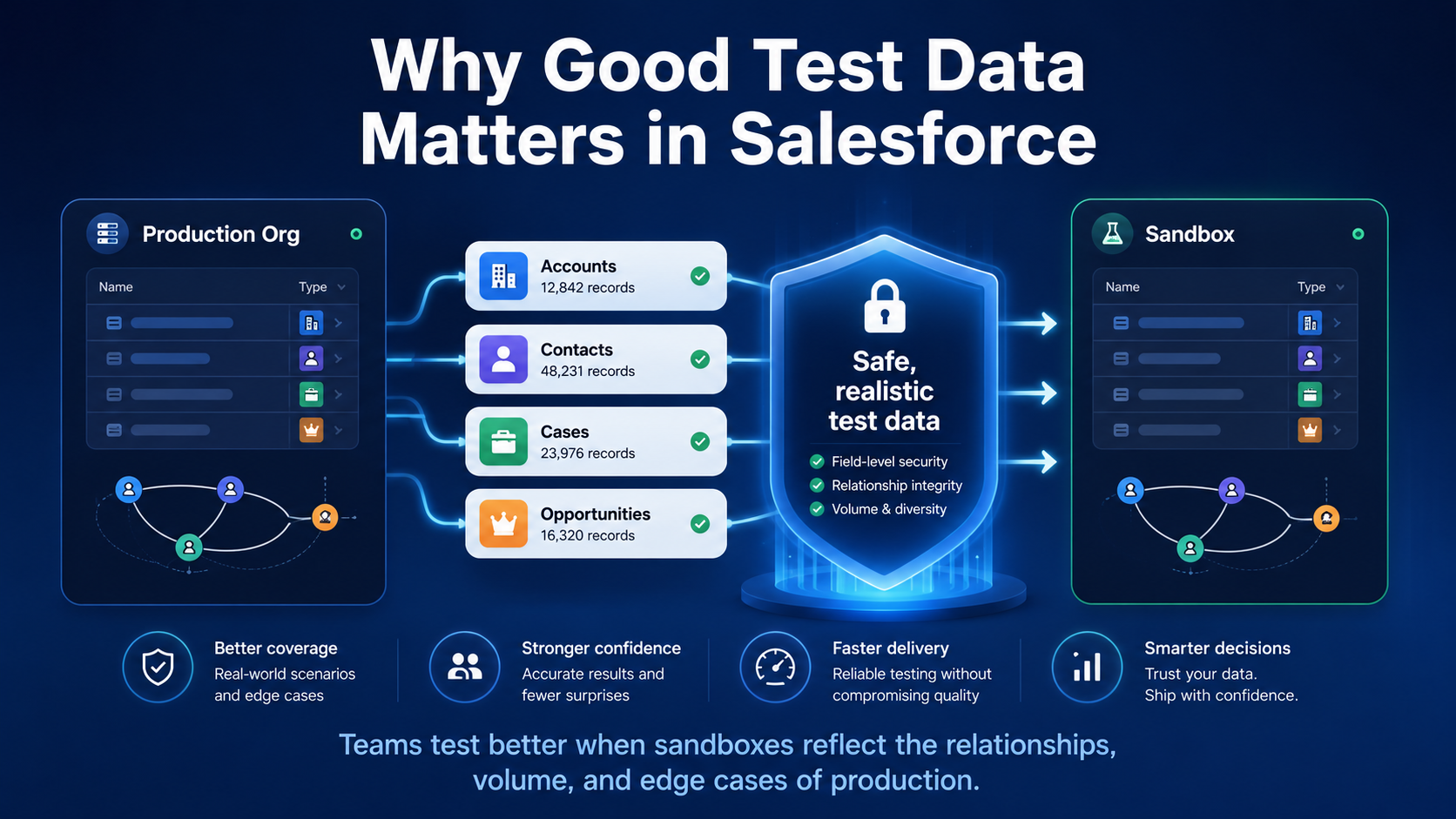
In Salesforce, a lot of testing looks good on paper.
A flow runs. An Apex test passes. A Lightning page loads. A user journey seems fine in a sandbox.
Then the change reaches production, and suddenly something breaks.
A validation rule fires in an unexpected way. A lookup relationship behaves differently. A report returns numbers nobody expected. A record-triggered flow touches data that never existed in the test environment. And just like that, the team is no longer testing the feature. They are debugging the gap between the sandbox and reality.
That gap is often a test data problem.
Good test data is one of the most underrated assets in the Salesforce ecosystem. It shapes how accurately teams can test, how confidently they can release, and how quickly they can solve problems before those problems reach production. When the data in a sandbox is too small, too artificial, or too incomplete, the entire testing process becomes less trustworthy.
And when teams cannot trust what they are testing, they slow down.
Test quality depends on data quality
Salesforce is not just fields and objects. It is relationships, automations, permissions, business rules, and exceptions layered on top of each other over time.
An Account may have Contacts, Cases, Opportunities, custom child records, integrations, approval history, and automation that behaves differently depending on record type, ownership, picklist values, or data completeness. The same is true across industries and orgs. Over time, even a well-designed org becomes a living system shaped by real usage.
That means realistic testing cannot happen with empty records or a few manually entered examples.
If your sandbox only contains thin samples of data, your team is not truly testing how the org behaves in the real world. They are testing a simplified version of it.
That is where risk begins.
The hidden cost of bad test data
Bad test data does not always look bad at first. Sometimes it looks clean. Minimal. Easy to manage.
But in practice, poor test data creates several problems.
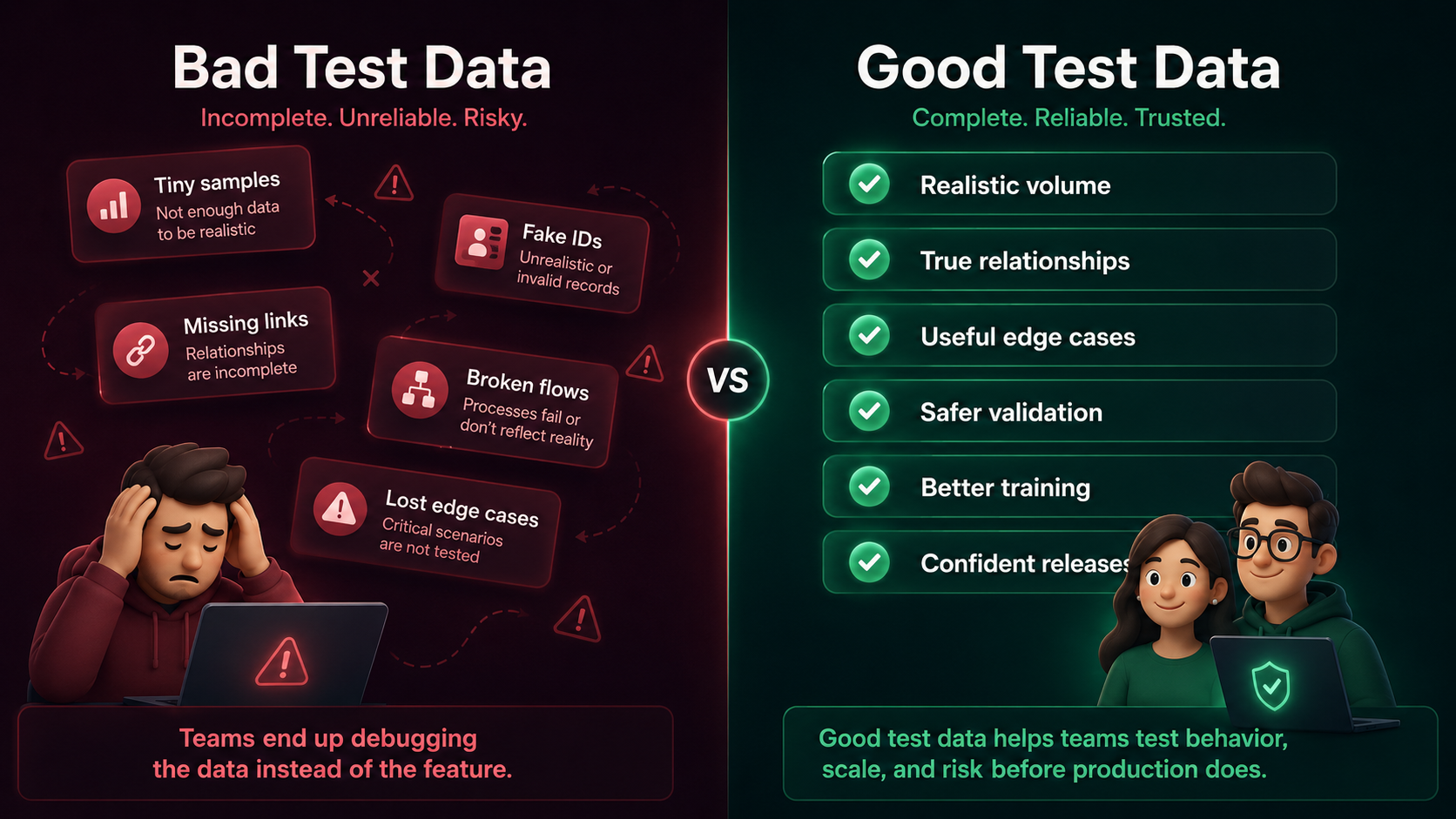
First, it hides edge cases. Teams validate the happy path but miss the combinations of field values, record histories, and object relationships that tend to cause real production issues.
Second, it breaks realism. A flow might work perfectly when tested against one record with three fields populated, yet behave differently when run against thousands of records with mixed values, inherited relationships, or partial data quality.
Third, it slows delivery. Teams lose time asking whether an issue is caused by the feature, the environment, or the fake data they used to test it.
Fourth, it weakens training and demos. Consultants, admins, and business users cannot meaningfully validate a process when the data does not feel believable.
And finally, it reduces confidence across the board. A successful test becomes less valuable when nobody is sure whether the sandbox actually represents production behavior.
That is a dangerous place to build from.
What good test data actually looks like
Good test data is not just more data.
It is relevant data. Structured data. Connected data. Data that reflects how the org is really used.
In Salesforce, good test data usually has five important qualities.
It reflects real relationships
Salesforce is deeply relational. Parent-child links, lookups, master-detail structures, and dependent objects all influence behavior.
If those relationships are missing or incomplete in a sandbox, you are not testing the system as users actually experience it.
It has realistic volume
Some issues only appear at scale. Batch behavior, page performance, list views, reports, automation timing, and integration patterns can all change when record counts increase.
Tiny sample sets rarely expose those problems.
It includes variety
Production data is messy. Different business units use fields differently. Some records are complete, others are not. Some values trigger special automation. Others reveal gaps in validation logic.
Good test data captures that diversity.
It preserves business context
A Contact is not just a Contact. It exists in a process. It belongs to a customer, a region, a lifecycle stage, a sales motion, or a support history.
When that context is missing, testing becomes abstract instead of operational.
It supports safe experimentation
Teams need realistic data, but they also need control. A sandbox should help them test confidently without introducing unnecessary risk.
That balance matters.
Why this matters to every Salesforce role
The importance of good test data goes far beyond developers.
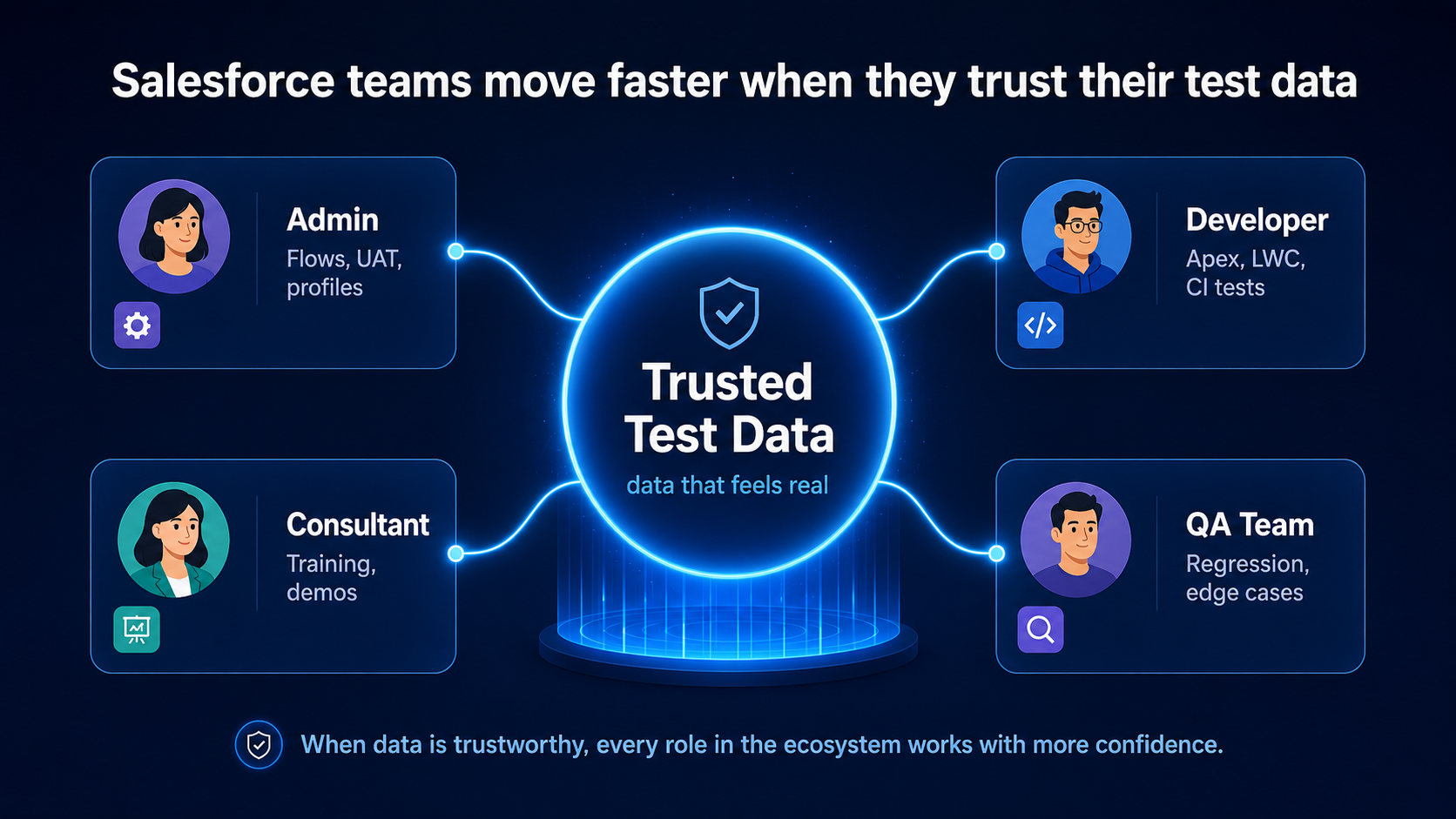
Admins need it to validate flows, permissions, page layouts, formulas, and automation changes.
Developers need it to test logic against realistic object structures and business scenarios.
QA teams need it to verify regression coverage and uncover edge cases before users do.
Consultants need it for demos, UAT, and training that actually reflect how the client works.
Business stakeholders need it to trust what they see when they review changes.
When test data is strong, everyone works with more confidence. When test data is weak, everyone inherits uncertainty.
Why sandbox realism changes the game
The closer your sandbox is to production reality, the more useful every test becomes.
That does not mean copying everything blindly. It means making sure the data teams build with is realistic enough to expose the truth.
Because the truth is what teams need.
They need to know whether a new automation will behave correctly across real data patterns. They need to know whether a UI change still works when objects are heavily connected. They need to know whether a release is genuinely ready, not just technically functional under ideal conditions.
Realistic sandbox data helps answer those questions earlier.
And earlier answers mean fewer surprises later.
The confidence gap in Salesforce delivery
One of the biggest challenges in Salesforce delivery is not building. It is believing.
Believing that the test result is meaningful. Believing that the sandbox reflects enough of production to trust the outcome. Believing that what passed in UAT will still hold up after deployment.
That confidence gap is expensive.
It leads to extra review cycles, slower signoff, defensive decision-making, and more post-release firefighting. Teams start compensating for uncertainty with process overhead.
But many times, the underlying issue is simpler: the environment did not give them enough truth.
Better test data narrows that gap.
The smarter way to test in Salesforce
The strongest Salesforce teams understand that testing is not only about code coverage or sandbox availability. It is about fidelity.
The better your test environment reflects production, the more reliable your decisions become.
That is why realistic data matters so much.
Not because it sounds good in theory, but because it improves what teams can actually do:
- validate more accurately
- catch more edge cases
- train more effectively
- release more confidently
- move faster with less rework
In other words, good test data is not a background detail. It is part of the delivery strategy.
Final thought
Salesforce teams do their best work when they can trust the environment they are working in.
A sandbox should not feel like a guess. It should feel like a safe, useful version of reality.
Because when test data reflects production more closely, teams stop spending energy compensating for missing context. They stop second-guessing whether the issue is real. They stop debugging the data instead of the change.
And that is when testing becomes what it was supposed to be all along: a source of confidence.
At SmartSeed, we believe better testing starts with better data.