
The Hidden Cost of Fake Test Data in Salesforce
Imagine rehearsing for a major theater performance with only two actors, half the props, no lighting cues, and a script where all the difficult scenes have been removed.
Opening night arrives. The full cast shows up. The real props are on stage. The pressure is on. And suddenly, everything that “worked perfectly in rehearsal” starts falling apart.
That is exactly what fake test data does in Salesforce.
On the surface, everything can seem fine. Flows pass. Apex tests pass. UAT gets signed off. Stakeholders feel good. The release moves forward.
Then production arrives with all its lovely chaos: real customer records, messy field values, missing data, duplicated data, strange edge cases, deeply connected objects, and years of business history stitched together through automations and relationships.
And suddenly the truth comes out.
The problem was never that the feature did not work. The problem was that the team never tested it in a world that looked anything like reality.
That is the hidden cost of fake test data.
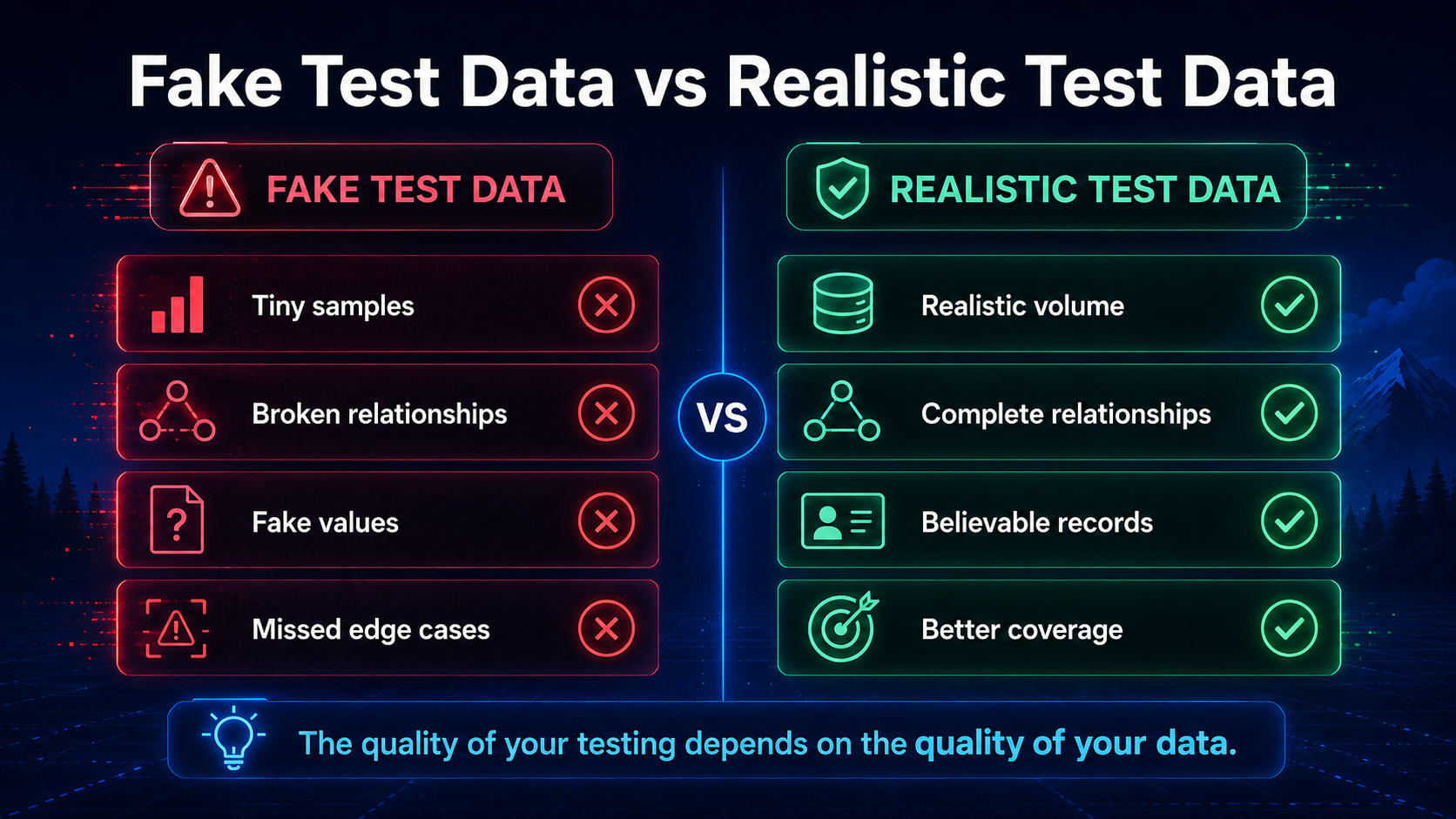
Fake test data feels productive — until it isn’t
There is a reason teams fall into this trap.
Fake data is quick. It is clean. It is convenient. It is easy to create a handful of Accounts, attach a few Contacts, populate some safe-looking values, and call it a test environment.
It even feels efficient.
No duplicates. No weird record histories. No confusing ownership. No incomplete fields. No messy exceptions. Just neat little records behaving exactly the way you hoped they would.
Which is also the problem.
Because production is not neat.
Production is where one record is missing a required field that somehow slipped through years ago. It is where a child record exists without the context your new logic assumed would always be there. It is where a lookup behaves differently because the real data model is full of real behavior, not idealized examples.
Fake test data creates a polite version of Salesforce. Production gives you the actual one.
And those are not the same thing.
The dangerous illusion of “all tests passed”
One of the most expensive sentences in software delivery is this one:
“But it worked in the sandbox.”
When teams use unrealistic test data, they often get a green light that means far less than they think.
The tests passed because the records were too simple.
The validation looked clean because the values were too predictable.
The flow worked because the relationship structure was too perfect.
The UAT was smooth because the users were testing an unrealistic version of their own business.
That is not confidence. That is borrowed optimism.
And borrowed optimism gets very expensive after deployment.
Why fake test data fails in Salesforce specifically
This problem exists in many systems, but Salesforce makes it especially important.
Why? Because Salesforce is not just an application. It is a living web of objects, automation, permissions, relationships, integrations, and user behavior.
A single change can be affected by:
- parent-child relationships
- lookup dependencies
- validation rules
- record-triggered flows
- Apex logic
- process variations across teams
- permission differences
- old data patterns no one documented
- incomplete or inconsistent record values
In other words, Salesforce behavior is deeply shaped by data.
Not just by whether a record exists, but by what it contains, how it is linked, how much of it exists, and how messy real business usage has made it over time.
That means unrealistic data does not just weaken testing a little. It can completely distort what the team thinks they have validated.
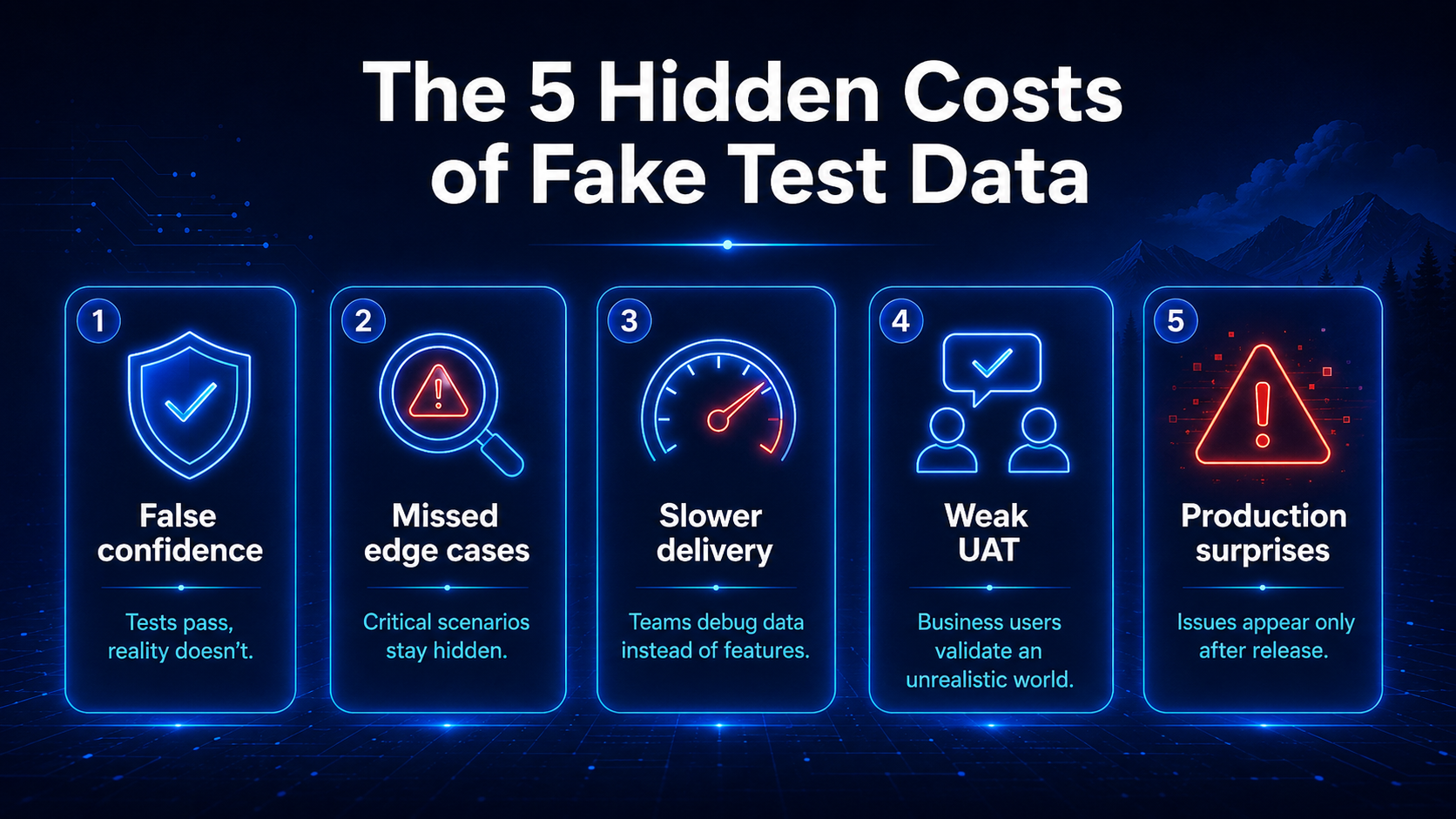
The five hidden costs of fake test data
1. False confidence
This is the biggest one.
Fake test data makes teams feel ready before they actually are. Everything looks stable because the difficult conditions never showed up.
The release moves forward. Stakeholders breathe easier. The checklist gets completed.
But the confidence was built on a simplified world.
It is like checking whether a boat floats by placing it in a bathtub and then assuming it is ready for the open ocean.
2. Missed edge cases
Edge cases are where many real production issues live.
A record with an unexpected value.
A missing parent.
An old record type.
A user-owned exception.
A combination of fields that almost never happens — until it does.
Fake data usually skips these situations because people naturally create “normal” records when they are building test sets by hand.
But production is full of abnormal reality.
And Salesforce loves to reveal that reality at the most inconvenient possible time.
3. Slower delivery
Poor test data does not make teams faster. It just delays where the pain happens.
Instead of finding issues during testing, teams find them after deployment, during hotfixes, in emergency debugging sessions, or while trying to explain to frustrated users why the “tested” release is behaving strangely.
This slows everybody down.
Admins lose time diagnosing automation behavior. Developers chase bugs that only exist because real data exposed assumptions. QA teams re-open work they believed was finished. Business users lose trust in the release process.
Fake data is fast at the beginning and expensive at the end.
4. Weak UAT
User acceptance testing sounds strong in theory. But UAT is only useful when users are testing something that feels like their actual world.
If the records are artificial, overly clean, or disconnected from real business context, then users are not validating reality. They are validating a demo.
That creates a dangerous gap between “approved in UAT” and “actually ready for production.”
And once that gap exists, the team starts relying on process language instead of real confidence.
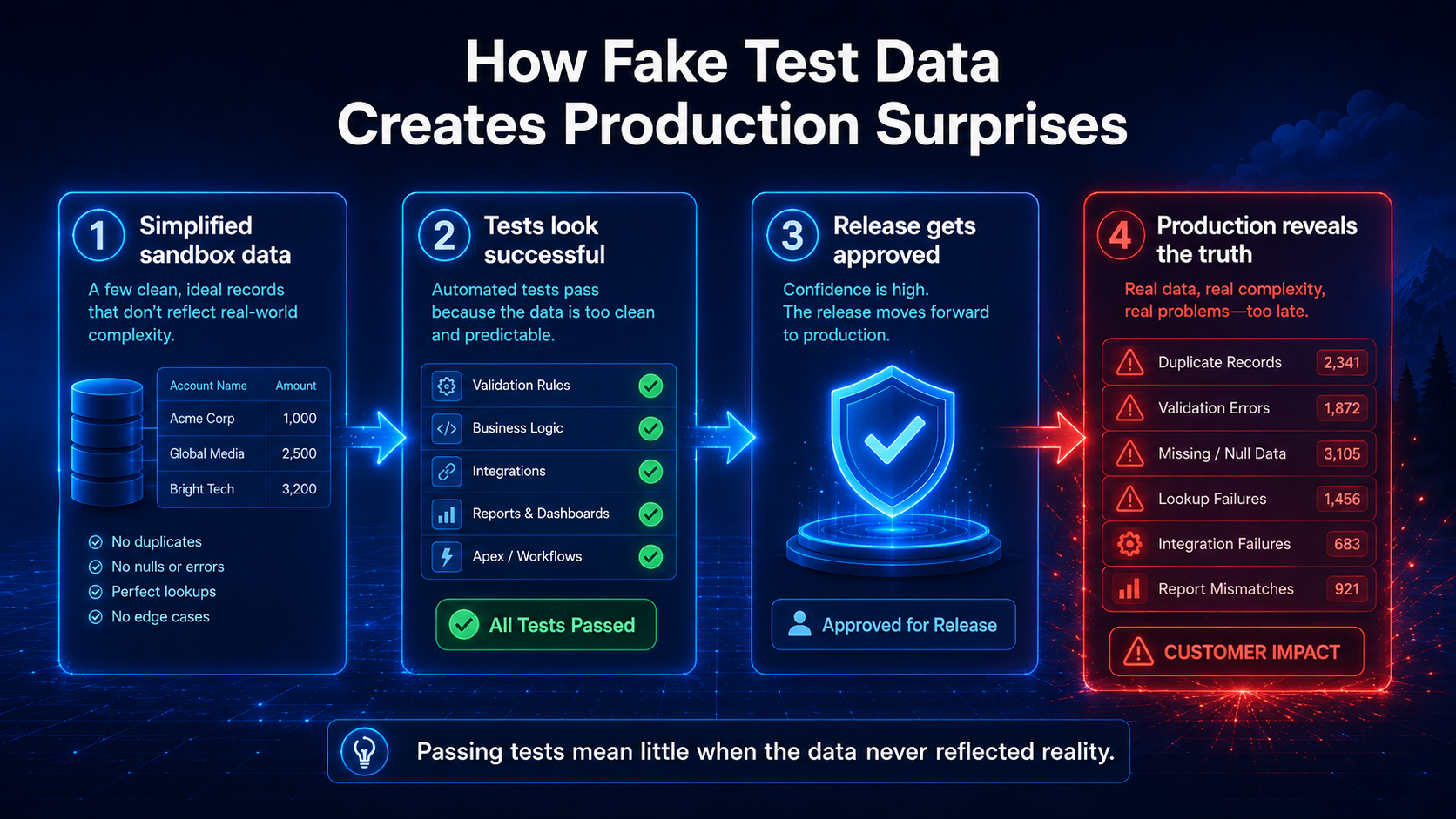
5. Production surprises
This is where everything becomes visible.
The release is live. Real records start moving through the process. Real automations fire. Real reports update. Real users click into scenarios nobody recreated in the sandbox.
And then the surprises begin.
Not because production is broken, but because production is honest.
It tells you what your testing environment failed to say.
What fake test data usually looks like
It is not always obviously bad. In fact, it often looks responsible.
It may look like:
- tiny sample sets with only a few records
- perfectly filled records with no gaps or inconsistencies
- records that are isolated instead of realistically connected
- made-up names and values that do not reflect real business patterns
- child records without meaningful parent context
- “happy path” scenarios with no exceptions
- clean datasets that avoid duplicates, nulls, and legacy oddities
In other words, fake test data often looks more organized than production.
And that should immediately make teams suspicious.
Because if your test environment feels much cleaner than reality, it is probably teaching you the wrong lessons.
What better test data looks like
Good test data is not just more data. It is more believable data.
It reflects:
- realistic record volume
- real parent-child relationships
- natural variation in values
- edge cases worth testing
- incomplete and messy records where appropriate
- business context that mirrors how users actually work
Good test data helps teams answer the right question:
“Will this still work when it meets reality?”
That is a much better question than:
“Did this work on the four records we created yesterday?”
Why this matters to more than just developers
It is easy to frame this as a developer problem, but it is bigger than that.
Admins need realistic data to validate flows, layouts, formulas, permissions, and automation behavior.
QA teams need it to understand whether testing coverage actually means anything.
Consultants need it for believable demos, stronger UAT, and more trustworthy solution validation.
Business users need it so they can test changes in an environment that resembles the real process they live in every day.
Leadership needs it because confidence in releases is not built by checklists alone. It is built by environments that tell the truth.
This is why test data quality is not a technical side issue. It is a delivery issue.
The real cost is not technical. It is organizational.
The most serious damage fake test data causes is not just bugs.
It is mistrust.
Mistrust in UAT.
Mistrust in testing.
Mistrust in release readiness.
Mistrust in whether “passed” actually means safe.
Once that trust starts to erode, teams compensate in predictable ways. They add more reviews. More signoffs. More meetings. More caution. More friction.
Everything slows down.
Not because the team lacks talent, but because the environment is not producing believable results.
And when teams cannot trust the result, they stop trusting the process.
A smarter way to think about sandbox readiness
A sandbox is not ready because it exists.
It is ready when it contains the kind of data that allows the team to test meaningfully.
That means realism matters.
Not because teams want to make testing harder, but because they want to make testing honest.
The closer a sandbox feels to production, the earlier teams discover the truth. And the earlier they discover the truth, the cheaper it is to act on it.
That is where tools like SmartSeed quietly become powerful.
Because the value is not just in moving data.
The value is in helping teams stop rehearsing in a fake world and start testing in one that actually teaches them something useful.
Final thought
Fake test data is comforting in the same way a practice exam with only easy questions is comforting.
It makes people feel prepared.
Until the real test begins.
Salesforce teams do not need more artificial reassurance. They need better signals. Better environments. Better confidence.
Because when sandbox data reflects real business reality more closely, testing becomes more honest, UAT becomes more meaningful, and releases become less surprising.
And that is the difference between hoping a release is safe and knowing it was tested in a world that mattered.
Test against reality, not wishful thinking
SmartSeed helps Salesforce teams build more realistic sandbox environments so testing, UAT, and release decisions can happen with more confidence.